Eyes, JAPAN
The Intelligence of the Swarm: Why Multi-Agent Systems (MAS) are the Future of Enterprise AI
Kumudu
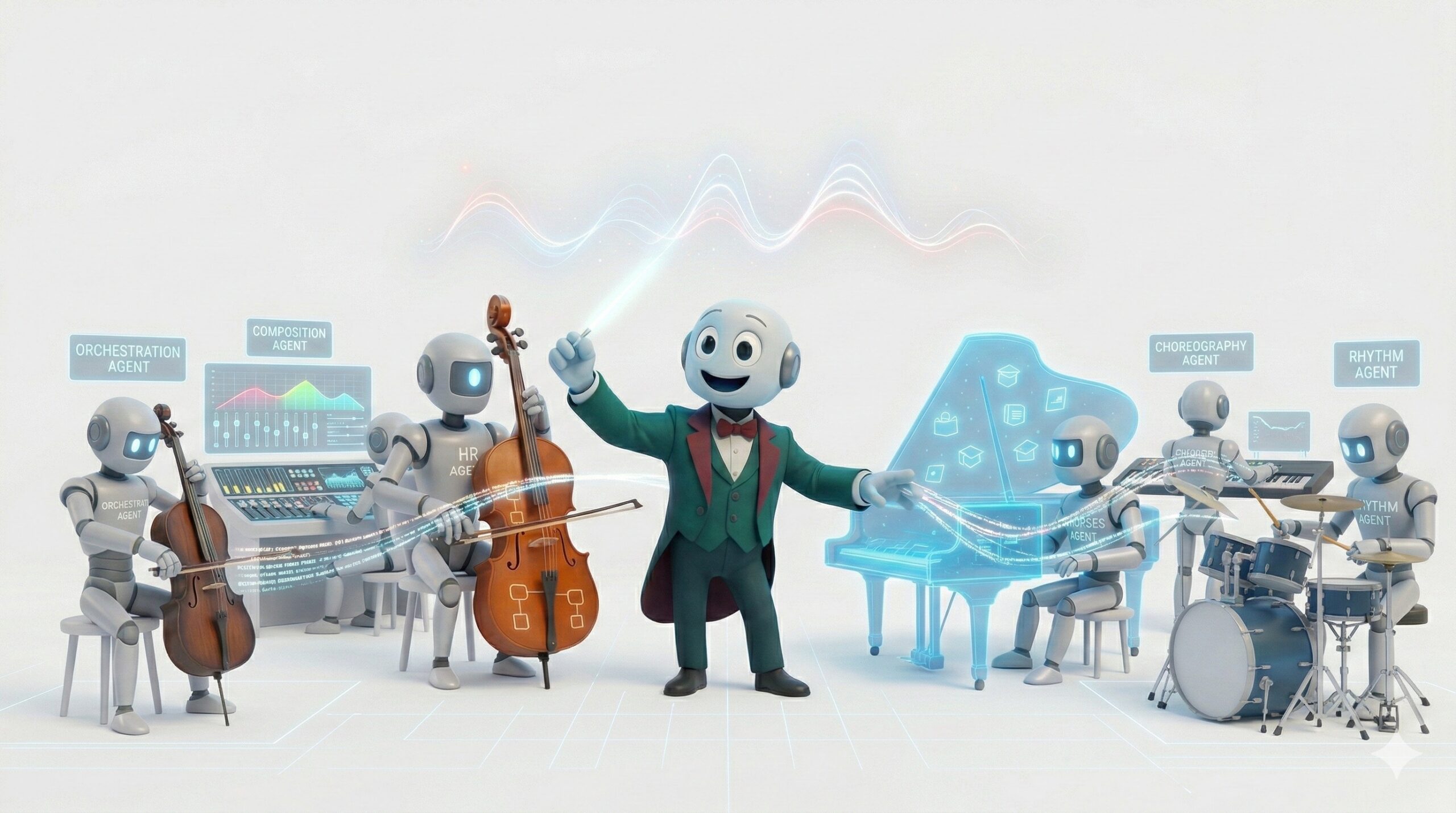
Agentic AI has evolved from simple chatbots into “journey owners” capable of managing end-to-end customer experiences. But as enterprises begin to scale these solutions, a new challenge emerges: complexity. If you try to build one “Super Agent” to handle everything—from legal compliance and real-time inventory to emotional customer support—it eventually hits a ceiling. In AI theory, we call this Context Dilution. The more an AI tries to know, the less precise it becomes.
The solution isn’t a smarter “lone wolf” AI. It’s a Multi-Agent System (MAS).
What is a Multi-Agent System?
To understand MAS, think of a high-end restaurant. You wouldn’t expect one person to seat the guests, cook the Wagyu steak, pair the wine, and manage the restaurant’s payroll simultaneously. If you did, the service would be chaotic, and the steak would almost certainly be burnt.
Instead, you have a team of specialists: a Maitre, a Executive Chef, and a Sommelier. Each is an “agent” with a distinct goal, yet they coordinate seamlessly to deliver a single outcome: a world-class dining experience.
In a Multi-Agent System, we apply this “Sociology of Intelligence” to AI. We decompose complex business goals into smaller, specialized agents that communicate, negotiate, and collaborate.
The Theory of Emergent Intelligence
The most compelling aspect of MAS is a concept known as Emergent Intelligence. This is the theoretical principle that a collective team can become significantly “smarter” than the sum of its individual parts.
Imagine a “missing package” dispute. You have a Billing Agent (an expert in transaction data) and a Logistics Agent (an expert in supply chain tracking). Neither agent was explicitly programmed with the “answer” to every unique dispute. However, by sharing their specialized insights, a solution emerges—the Billing Agent confirms the payment was valid, the Logistics Agent identifies a carrier delay, and together they trigger an automated proactive refund.
Intelligence, in this case, isn’t a pre-written script; it’s a byproduct of collaboration.
How Do They Work Together?
In the theoretical framework of MAS, agents typically coordinate through two primary models:
-
Orchestration (The Conductor): A “Manager Agent” sits at the center of the workflow. It receives the high-level request, decomposes it into actionable tasks, and delegates them to specific “Worker Agents.” It is a structured, hierarchical approach, much like a project manager leading a technical team.
-
Choreography (The Dance): This is a decentralized model where there is no “boss.” Agents react to changes in their environment. For instance, if the Inventory Agent notices a SKU is out of stock, it “broadcasts” this event. The Marketing Agent hears this and automatically pauses all active ad campaigns for that product. It is a fluid, responsive “digital ecosystem.”
Why the Enterprise Needs a “Digital Workforce”
Moving from a monolithic AI to a Multi-Agent System offers three strategic advantages:
-
Precision through Specialization: By narrowing an agent’s Domain of Competence, you virtually eliminate hallucinations. An agent only acts when the task falls within its specific expertise.
-
Systemic Resilience: In a monolithic system, a single failure point can take down the entire operation. In a MAS architecture, if your “Currency Conversion Agent” goes offline, your “Customer Support” and “Order Management” agents continue to function. The system “degrades gracefully” rather than crashing.
-
Scalable Autonomy: As your business grows, you don’t need to retrain your entire AI model. You simply “onboard” a new specialist—such as a Warranty Agent or a Compliance Agent—and integrate them into the existing swarm.
The Swarm is the Future
The future of Enterprise AI is not a single, all-knowing brain; it is a collaborative network of specialized intelligences working in harmony.
By shifting our perspective from “What can one AI do?” to “How can a team of AI agents collaborate?”, we unlock a level of operational autonomy that was previously science fiction. In the coming years, the most competitive enterprises won’t just have the best AI—they’ll have the best-coordinated AI teams.
- Tweet
-

 2026/03/20
 2026/02/27
 2026/01/23
 2025/12/12
 2025/12/07
 2025/11/06
 2025/10/31
 2025/10/24