Eyes, JAPAN
Beyond Chatbots: End-to-End Customer Journeys Powered by Agentic AI
Kumudu
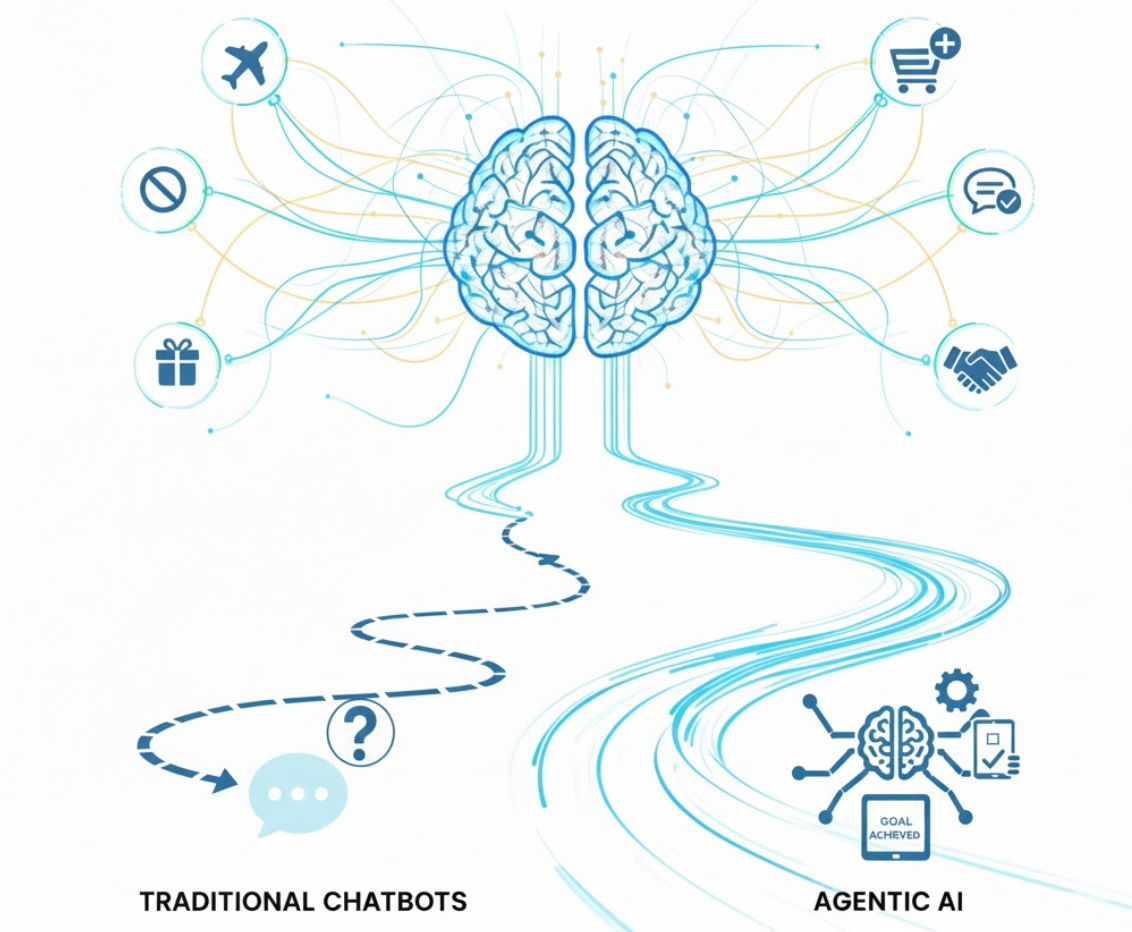
Most organisations already “have AI” in customer service—usually a chatbot on the website or a virtual assistant in the app. But if you look at the metrics that matter—first-contact resolution, NPS, cost-to-serve—many journeys are still fragmented. Customers get answers, not outcomes.
The reason is simple: traditional chatbots sit at the front of the journey. They answer questions or log tickets, then hand everything back to humans and legacy systems.
Agentic AI is different. These agents are designed to own a goal (“rebook my trip”, “fix my billing issue”), not just a conversation. Equipped with reasoning and secure access to systems, they can plan, act and coordinate across the entire journey.
From Chatbots to Journey Owners
| Traditional chatbots: | Agentic AI agents: |
| Follow predefined decision trees Live mainly at the FAQ or triage layer Break when the request spans multiple systems or exceptions | Adapt when data is missing, rules conflict, or the situation is unusual Start from a goal, not just an intent Break it into steps: verify, check, decide, update, confirm Call tools and APIs to actually do things in CRM, billing, order management, etc. |
Instead of “chat in front, humans at the back,” AI becomes an orchestrator for channels, systems and human experts.
What End-to-End Actually Looks Like
1. Travel: Disruption to Rebooking – Flight cancelled.
| Old model | Agentic model |
| chatbot provides a status update and a support link. | the AI agent detects the disruption, reaches out proactively, checks fare rules and inventory, rebooks within policy, handles vouchers or hotels where applicable, updates the booking and sends confirmations. |
For the customer, it’s not a chat—it’s a resolved disruption.
2. Retail: Return to Refund – Return requested.
| Old model | Agentic model |
| Chatbot shares policy links and maybe generates a return label. | the agent validates the order, checks product and warranty, decides whether to offer instant refund or credit, triggers logistics (label, pickup, locker), updates inventory and loyalty, and sends tracking and confirmation. |
The difference is ownership of the full return-to-refund journey, not just the first interaction.
Why Enterprises Care
Once agents can run end-to-end journeys, impact shows up quickly:
- Higher first-contact resolution – The agent doesn’t stop at explaining; it completes the task.
- Lower average handling time – Multi-step work is automated across systems instead of stitched together manually.
- Better CX – Fewer transfers, less “please call this number”, more “it’s done”.
- Lower cost-to-serve – Human agents focus on complex exceptions and high-value conversations.
What You Need Under the Hood
Moving beyond chatbots requires a bit more than just plugging in an LLM.
- Goal-driven agents
- Clear objectives like “resolve billing dispute” or “process return.”
- Ability to plan multi-step flows and choose actions based on context and rules.
- Access to tools and data
- Secure connectors to CRM, billing, ticketing, order management and logistics.
- A simple tool layer the agent can call to read and write data, not just search knowledge.
- Guardrails and human-in-the-loop
- Explicit policies: what the agent can do autonomously vs. when it must ask for approval.
- Spend limits, risk rules and PII protections built in.
- Easy escalation to a human when the case is high value, high risk or emotionally sensitive.
With this foundation, the agent can move from “supporting chat” to running journeys.
Common Design Patterns
Pattern 1: AI as Front Door + Orchestrator
Best for: general customer service, IT support, HR helpdesk
- The agent is the entry point on web, app and messaging.
- It does triage and executes back-end actions.
- When a human steps in, they see everything the agent has already done.
Pattern 2: Proactive Journey Owner
- The agent is triggered by events: flight disruption, payment failure, churn risk.
- It reaches out with options, makes recommendations and completes flows autonomously where policies allow.
Best for: retention, collections, logistics updates, high-value accounts.
How to Get Started (Without Rebuilding Everything)
You don’t need to redesign your entire CX stack. Start small, but think end-to-end.
- Choose one concrete journey, not a channel
For example: “billing dispute”, “delivery issue”, “flight disruption”. Map it from trigger to final outcome. - Define success clearly
What does “good” look like? One interaction, within X minutes, with fewer than Y handoffs. Design your agent around that. - Give agents safe autonomy
Let the agent fully resolve low-risk, low-value cases (e.g., refunds under a certain amount) with clear escalation rules for everything else. - Design a great co-working experience for humans
Make sure agents can see what the AI has already done, correct it easily and feed back improvements. Otherwise, you just move frustration from customers to employees. - Measure and iterate
Track first-contact resolution, CSAT, AHT, escalation rate and error patterns. Use these signals to refine prompts, tools and policies continuously.
Beyond Chatbots, Toward Outcome Engines
Putting a bot on your website is no longer a differentiator. The real shift is turning AI into an outcome engine—agents that can understand intent, navigate complexity and deliver end-to-end results reliably.
Enterprises that make this move aren’t just answering more queries. They are:
- Resolving more journeys in a single interaction
- Turning service into a loyalty and growth driver
- Redesigning how people, processes and technology work together around the customer
That’s what it really means to go beyond chatbots.
- Tweet
-

 2026/02/27
 2026/01/23
 2025/12/12
 2025/12/07
 2025/11/06
 2025/10/31
 2025/10/24
 2025/10/03