Eyes, JAPAN
Causality Detection in AI: Moving Beyond Correlation
Charu
Artificial Intelligence has made remarkable progress in recent years, especially in areas like prediction, classification, and pattern recognition. However, one fundamental limitation still persists in most AI systems: they understand correlation, not causation.
In real-world decision-making, this limitation can lead to misleading insights and poor outcomes. This is where causality detection comes into play—a powerful approach that aims to uncover why things happen, not just what is happening.
What is Causality Detection?
Causality detection is the process of identifying cause-and-effect relationships between variables.
For example:
-
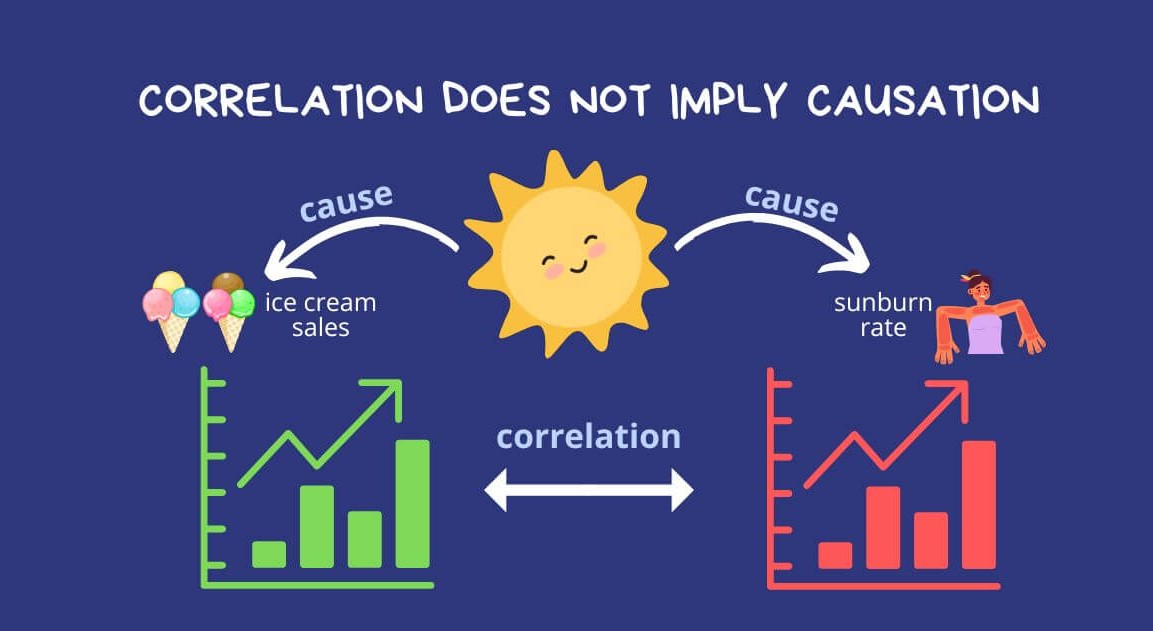
Correlation: Ice cream sales and drowning incidents both increase in summer.
-
Causation: Hot weather increases both ice cream consumption and swimming activity.
Traditional machine learning models might detect the correlation but fail to identify the underlying cause.
Causality detection helps answer deeper questions like:
-
Does X actually cause Y?
-
What happens if we intervene in a system?
-
Can we predict outcomes under different scenarios?
Where Does Causality Detection Fit?
Causality detection is an interdisciplinary field that lies at the intersection of:
-
Machine Learning
-
Statistics
-
Data Science
-
Econometrics
-
Artificial Intelligence
-
Philosophy of Science
It is often studied under:
-
Causal Inference
-
Probabilistic Graphical Models
-
Bayesian Networks
Why Correlation is Not Enough
Most AI models are trained to optimize predictive accuracy. While this works well in controlled environments, it often fails in dynamic, real-world systems.
Problems with correlation-based systems:
-
Spurious relationships (false patterns)
-
Lack of interpretability
-
Poor generalization under changing conditions
-
Inability to handle interventions
Causal models, on the other hand, provide:
-
Better decision-making
-
Robustness to distribution shifts
-
Explainability
-
Counterfactual reasoning (“What if?” analysis)
Key Concepts You Need to Learn
To understand and work with causality detection, here are the core concepts:
1. Structural Causal Models (SCM)
These models represent relationships using equations and directed graphs.
2. Causal Graphs (DAGs)
Directed Acyclic Graphs (DAGs) are used to visualize cause-effect relationships between variables.
3. Confounding Variables
Hidden variables that influence both cause and effect, leading to misleading conclusions.
4. Intervention (do-operator)
Introduced by Judea Pearl, it allows us to simulate real-world interventions.
5. Counterfactuals
Answering questions like:
“What would have happened if X had not occurred?”
Techniques for Causality Detection
Some widely used methods include:
Constraint-Based Methods
-
PC Algorithm
-
FCI Algorithm
Score-Based Methods
-
Bayesian Network Structure Learning
Granger Causality
Used mainly in time-series data to determine if one variable predicts another.
Structural Equation Modeling (SEM)
Combines statistical and causal reasoning.
Deep Learning Approaches
Recent research integrates neural networks with causal inference.
Real-World Applications
Causality detection is becoming critical in many domains:
- Healthcare: Understanding whether a treatment actually causes improvement.
- Finance: Identifying real drivers of market movements.
- Marketing: Measuring the true impact of campaigns.
- Industrial Systems: Detecting root causes of failures rather than just anomalies.
- Policy Making: Evaluating the effects of interventions and regulations.
Challenges in Causal AI
Despite its potential, causality detection comes with challenges:
-
Requires strong assumptions
-
Data limitations (observational vs experimental)
-
Computational complexity
-
Difficulty in validating causal relationships
The Future of AI is Causal
As AI systems become more integrated into critical decision-making, the need for causal understanding will only grow.
Future AI systems will not just:
-
Predict outcomes
But also:
-
Explain decisions
-
Recommend interventions
-
Adapt to changing environments
Causality detection is a key step toward building trustworthy and intelligent systems.
Final Thoughts
We are entering a new phase of AI—one that goes beyond pattern recognition to true understanding.
Causality detection enables us to move from:
-
“What is happening?”
to -
“Why is it happening?”
And ultimately:
-
“What should we do about it?”
- Tweet
-

 2026/03/20
 2026/03/20
 2026/02/27
 2026/01/23
 2025/12/12
 2025/12/07
 2025/11/06
 2025/10/31